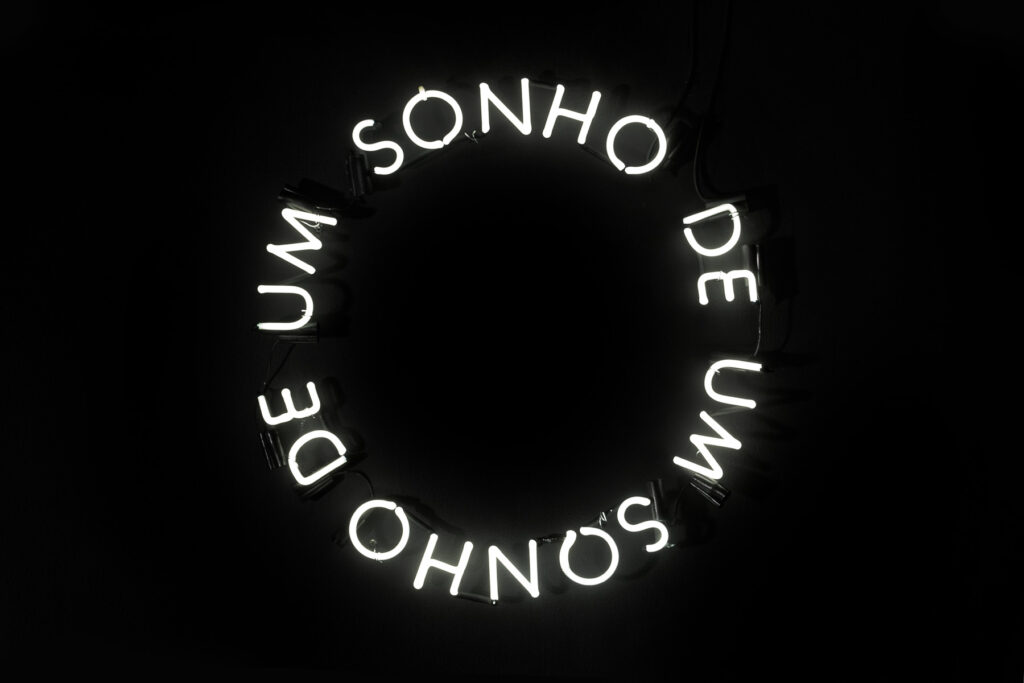
Felippe Moraes
Sonho de um Sonho (Dream of a Dream),
from the SAMBA EXALTAÇÃO series, 2023
Neon
60 × 60 cm
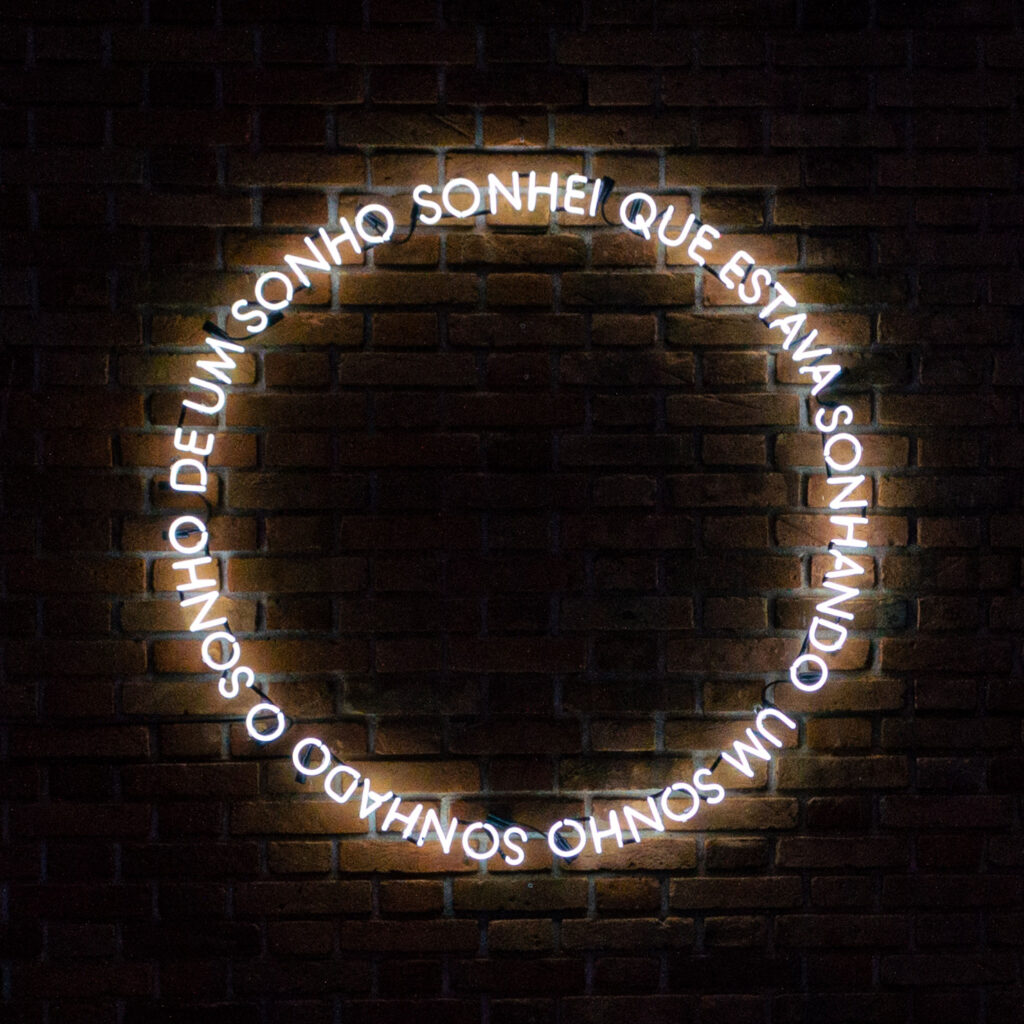
Felippe Moraes
Sonho de um Sonho,
from the SAMBA EXALTAÇÃO series, 2021
Neon
130 × 130 cm
The work Sonho de um Sonho (2023), by Felippe Moraes, consists of a circular neon sign displaying the title of the samba of the same name by Martinho da Vila. The phrase is written continuously around the circle, creating a potentially endless, uninterrupted reading. With no defined beginning or end, the text seems to spin on itself, suggesting the idea of a dream that holds other dreams within it.
This circular structure sets up a visual metaphor for the poetic construction of the verse itself. By repeating continuously, the phrase creates a kind of spiral of meaning — a dream within a dream, which in turn holds new imaginary unfoldings. The neon, with its constant, vibrant light, reinforces this sense of continuous flow.
The work takes as its reference the samba-enredo “Sonho de um Sonho”, composed by Martinho da Vila for the samba school Unidos de Vila Isabel and performed at the 1980 Carnival at the Sambódromo da Marquês de Sapucaí.
The samba was created at a particular historical moment in Brazil. In the late 1970s and early 1980s, the country was slowly beginning to break free from the military dictatorship established in 1964. In this context, the Vila Isabel parade evoked an atmosphere of hope and transformation.
“Open minds
No silenced beaks
Youth on alert”
And still the striking aspiration for a country where “imprisonment without torture” could exist.
Sung at the top of their lungs on the avenue, these words echoed as a symbolic expression of a moment of historical transition, in which the collective imagination projected possibilities of transformation for the future.
Inspired by the poem “Sonho de um Sonho”, by Carlos Drummond de Andrade, the song brought together images of freedom and collective desire.
Light, Circularity, and Time
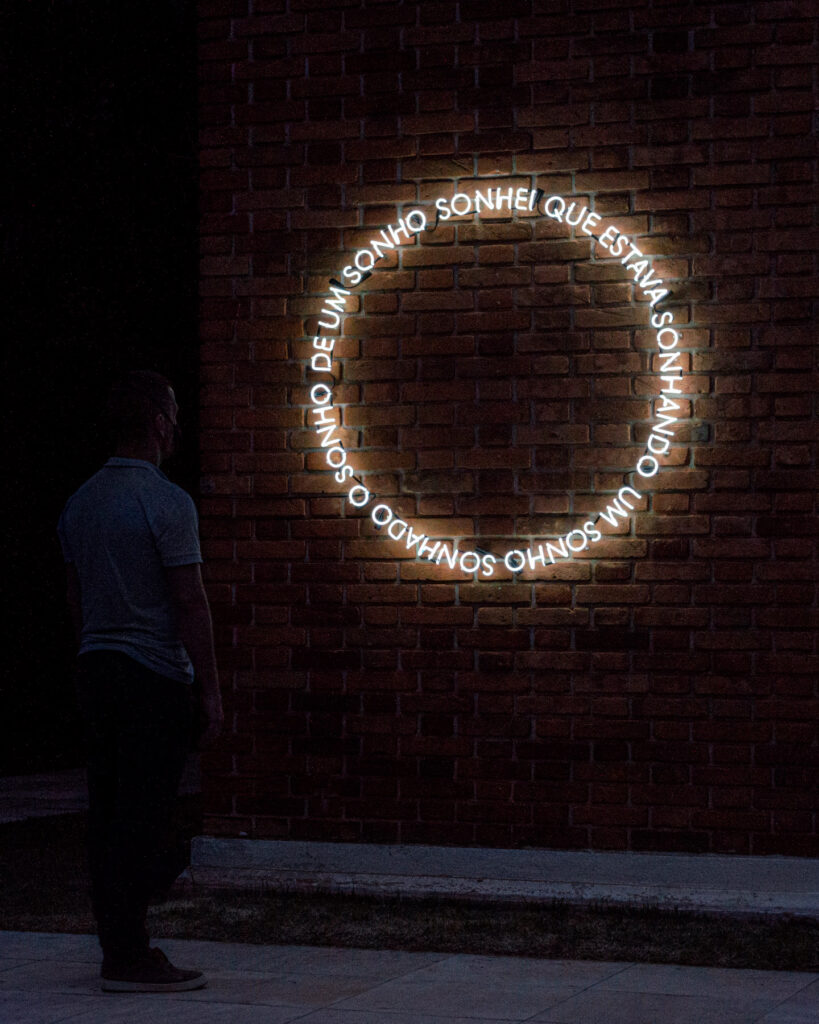
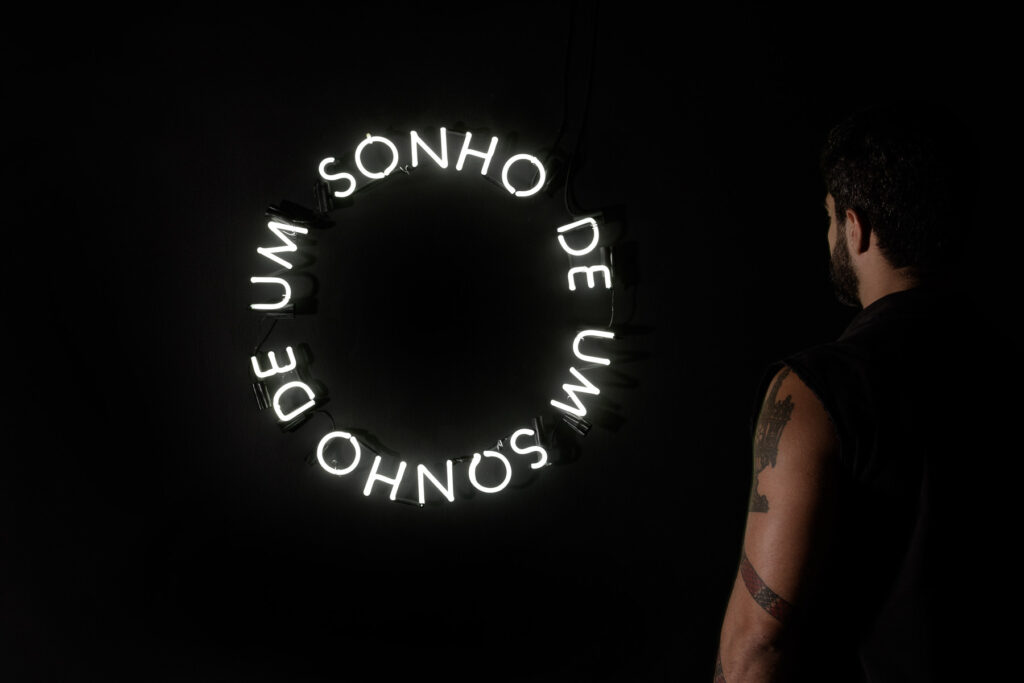
By turning the title of this song into a circular neon sign, Moraes creates a visual device that connects language, history, and cultural memory. The circularity of the phrase not only suggests the idea of infinite repetition, but also establishes a symbolic relationship with the cyclical time of popular festivities and of Carnival itself, which returns year after year.
The neon’s continuous light reinforces this temporal dimension. Unlike a phrase printed or written on paper, the luminous text projects itself into space and becomes an environmental presence. The verse ceases to exist only as a sonic memory and comes to operate as image and atmosphere.
In this way, the work connects different cultural layers: the world of samba, Brazilian modernist poetry, and the country’s recent political history.
Two Versions of the Same Work
Sonho de um Sonho exists in two distinct versions, which explore different scales of the same idea.
The first version presents only the shortened phrase “Sonho de um sonho,” written in a circle roughly 60 cm in diameter. In this configuration, the phrase works as a condensed poetic core, emphasizing the repetition and continuity of the statement.
The second version expands the work’s scale to around 130 cm in diameter and presents a longer excerpt of the samba.
This version further expands the play of reflexivity present in the lyrics, creating a linguistic chain that seems to fold the very act of dreaming back on itself.
Selected Exhibitions
- 2025 – Solfejo – CAIXA Cultural Curitiba (Paraná, Brazil)
- 2025 – Solfejo – CAIXA Cultural Rio de Janeiro (Rio de Janeiro, Brazil)
- 2024 – Solfejo – CAIXA Cultural Brasília (Distrito Federal, Brazil)
- 2023 – Ovo Cósmico – Verve Galeria (São Paulo, Brazil)