Ovo Cósmico (Cosmic Egg), 2023
Solo exhibition
Verve Galeria
São Paulo – Brazil
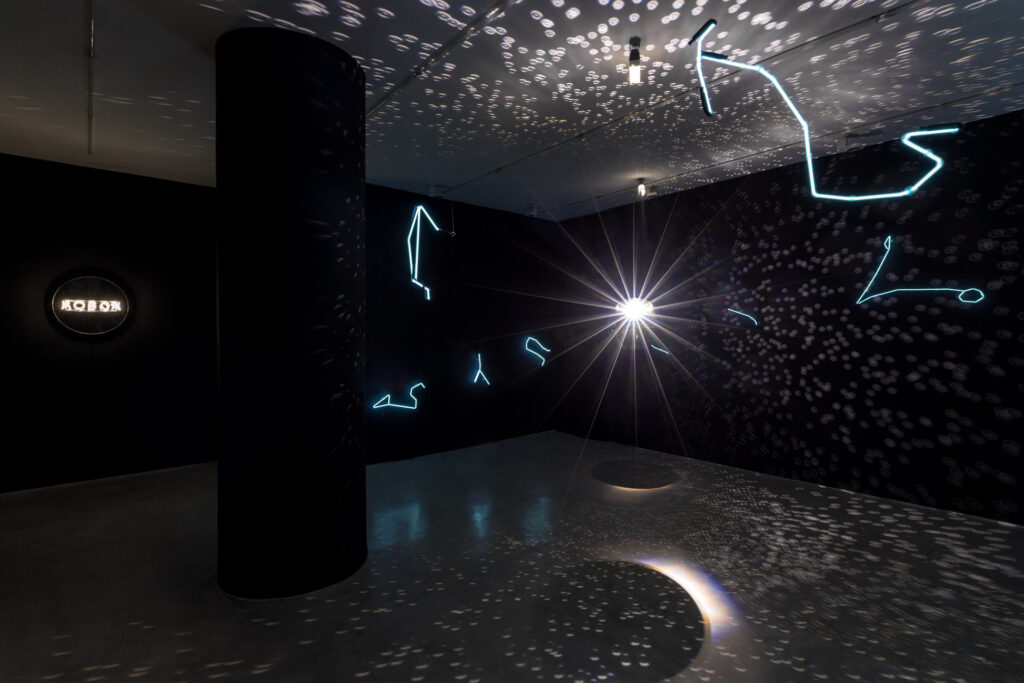

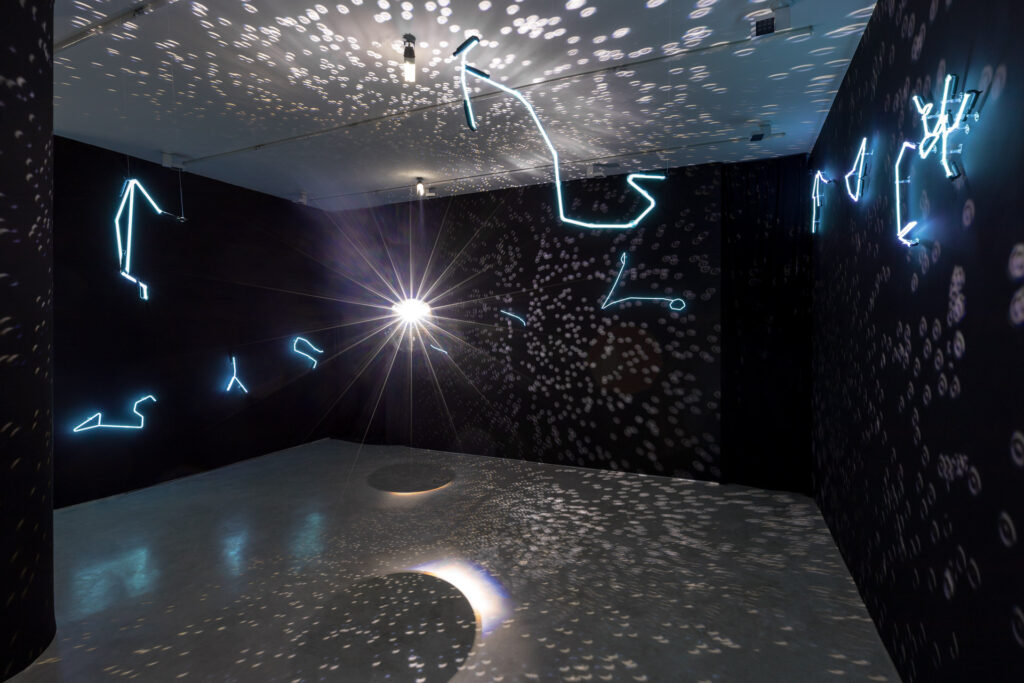
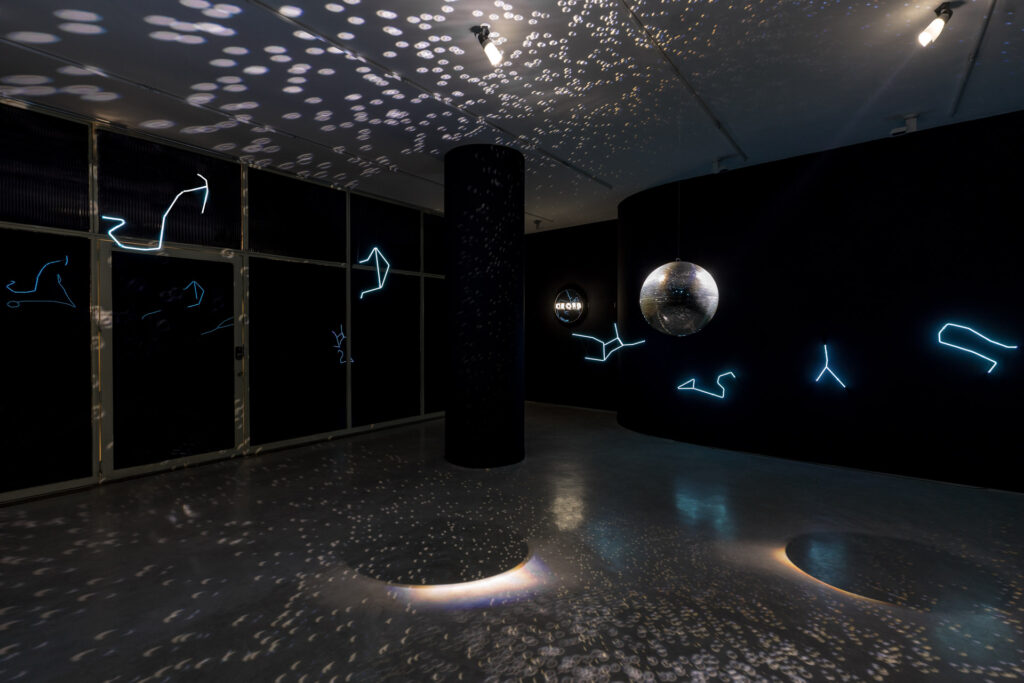
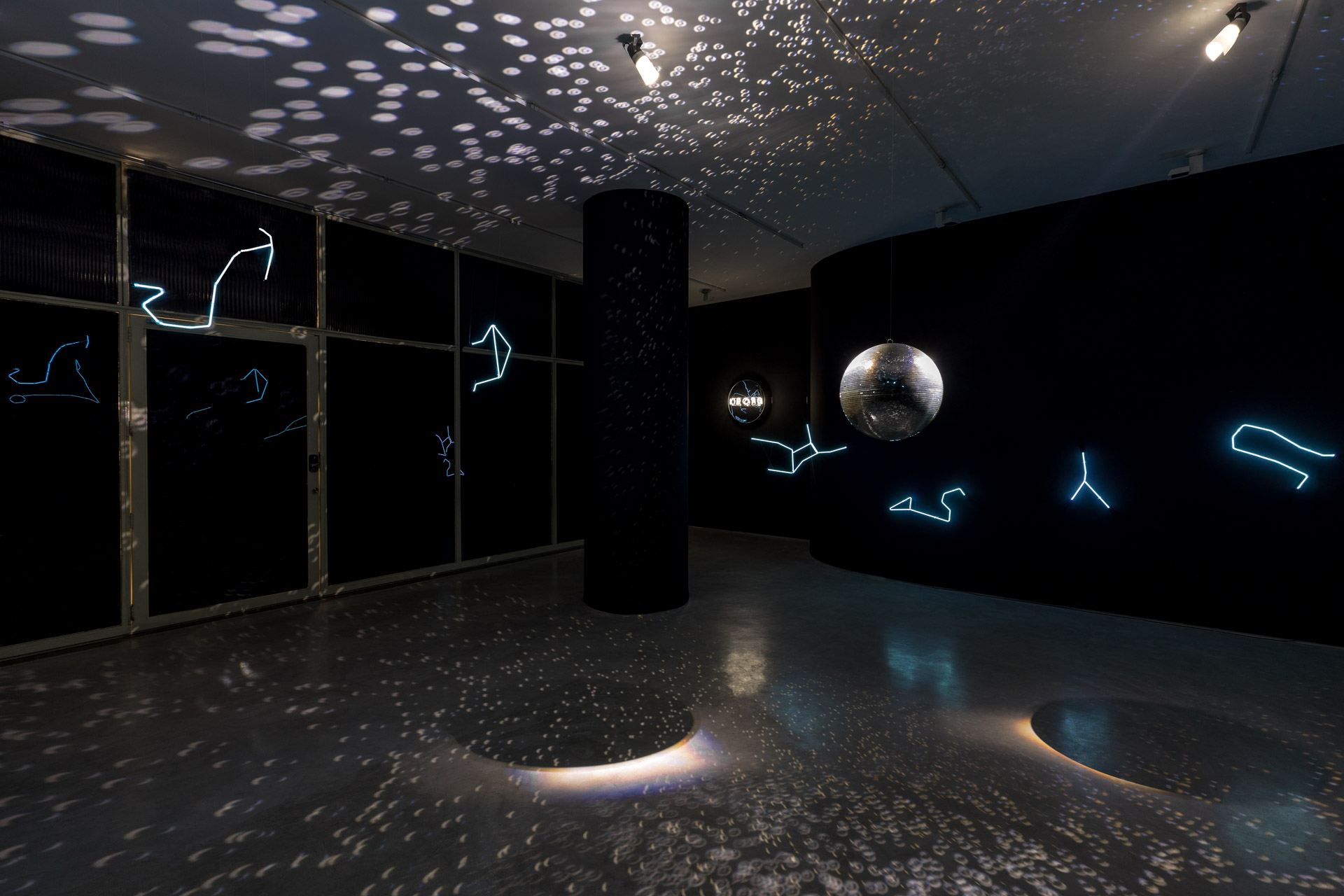
The exhibition OVO CÓSMICO, by Felippe Moraes, presented at Verve Galeria, creates an immersive experience by completely transforming the exhibition space into an environment suspended from time and material reality. Bringing together 16 new works, all luminous, the show invites the public to move through a landscape evoking the immensity of the universe and the sensation of floating among celestial bodies.
The exhibition weaves together neon, mirrors, and moving images to build a sensory field in which science, spirituality, and the collective unconscious intertwine. The works stem from investigations into the music of the spheres, alchemy, and celestial bodies, creating a path that shifts perception and puts pressure on the boundaries between rational knowledge and sensory experience.
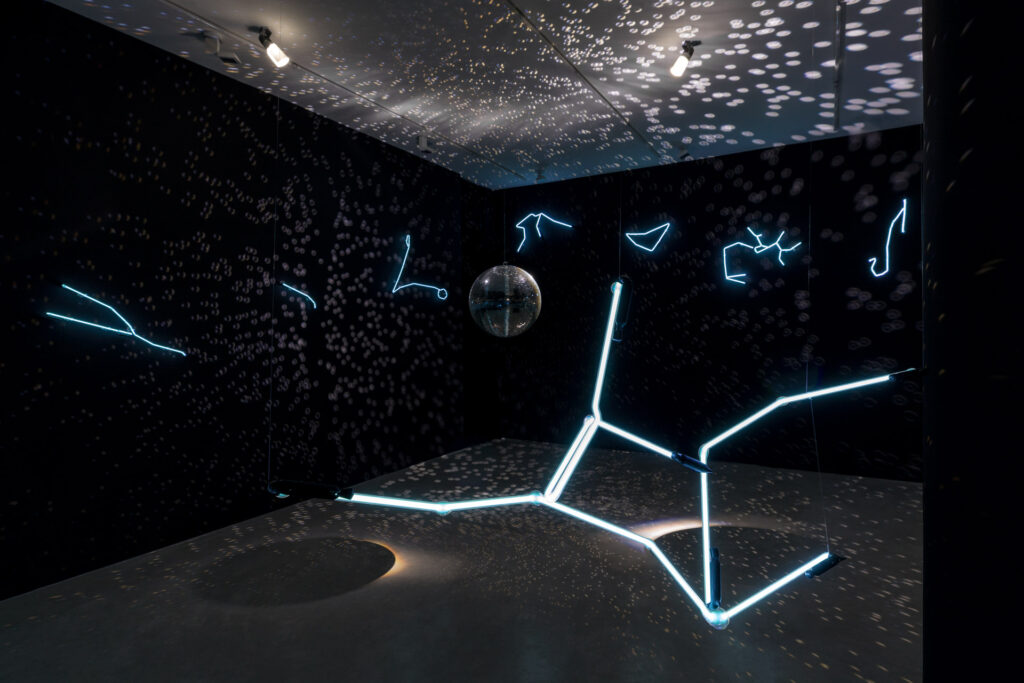
At the center of the show, the installation Solaris Discotecum (2023) organizes the space as an orbital system, in which zodiac constellations and luminous elements relate to one another in continuous motion. The presence of materials such as argon, associated with the formation of stars, reinforces the exhibition’s physical and symbolic dimension, bringing the visitor closer to a matter that points back to the origin of the cosmos.
Taking on the exhibition design and curatorial text himself as well, Felippe Moraes conceives the show as a total work. OVO CÓSMICO proposes an encounter with ancestral questions about origin, time, and existence, opening a field of contemplation in which aesthetic experience also becomes an exercise in thinking about that which exceeds us.
Curatorial Text
Ovo Cósmico – Felippe Moraes
“Tem uns dias que eu acordo
Pensando e querendo saber
De onde vem o nosso impulso
De sondar o espaço (…)
E de pensar que não somos
Os primeiros seres terrestres
Pois nós herdamos uma herança cósmica”
Errare Humanum Est – Jorge Ben Jor, 1976
When struck by the crushing weight of material reality, we turn our eyes upward and downward, inward and outward. Between infinities, the instants of our existence unfold. Under the paradox that within their impermanence lies access to what is eternal and infinite. It is in this negligible membrane, almost without dimension, that our existences take place.
It is behind the visible horizon that the unspeakable hides — the events for which we lack the vocabulary to describe. Confronted with the vastness of what exceeds us, it is then that we draw closer to the notion of our own transience and material impermanence.
There are questions and whispers that are born with all of us. They may be heard or ignored. Addressed or not, they accompany us like our shadows. So it was with our ancestors, and so it will remain in the future, until we ourselves become ancestors. Many of us allow ourselves to immerse in these deep waters only at the instant of death, of passing. In materialist illusion, we deprive ourselves of the cosmic joy of feeling ourselves exactly as we are: fleeting instants within eternity. At times enduring, at times living for a single second. At times minuscule, at times colossal.
OVO CÓSMICO establishes itself as an aesthetic, symbolic, and spiritual experience. The microcosm of an initiatory journey that proposes, through the observation of celestial models, a gaze turned toward the inner cosmos. It proposes itself as a contemplation of infinitude and of questions without answers. With them, we learn to float in the sea of uncertainty as the very condition of eternal beings set within a succession of small, repetitive, finite experiences.
Let us imagine the universe as a curve. As a circular time, allowing for an eternal return, a reiteration of cycles. Of departures that end up becoming returns. If I were to prostrate myself before the infinite void, at a given moment I would see the back of my own neck: its image traveling along the infinite curve until it reached my eyes. The place immediately prior to the one from which I myself observe. This is what OVO CÓSMICO proposes. In contemplating the eternal blackness of night, we would arrive at the inflection point of creation. The first moment from which the visible and invisible order of the cycles surrounding us arose. The point of departure. The first light. The moment of the first Word. The primordial mound from which everything emanates.
The James Webb Space Telescope, launched in 2021, is one of the greatest scientific undertakings in human history and was designed to allow the observation of the deepest reaches of space, toward the point of the Big Bang event. Understanding that the more deeply we observe space, the further into the past we look, the goal would be to reveal photographs of the Universe’s first instants. The ancestral milliseconds. The first breath of infinity. The birth of the cosmos.
OVO CÓSMICO proposes itself in an analogous way. As an aesthetic and poetic device that allows us to observe the depths of our symbolic and ontological origins. Through visual, kinetic, and sensory experiences, to promote a gaze toward our celestial and mythological models in order to see our own instant of conception.
In OVO CÓSMICO there is the establishment of an environment that evokes and invokes symbols, narratives, and mythologies repeated again and again across different traditions. Within it, we place ourselves in order to ask the old questions — whose form, tenor, and content we have forgotten within a civilization that hides in the flavorless clarity of instrumentalized knowledge. There is here no flight from science, but an attempt to hurl ourselves once more into mystery, into ontological suspension. The place from which it itself emanates.
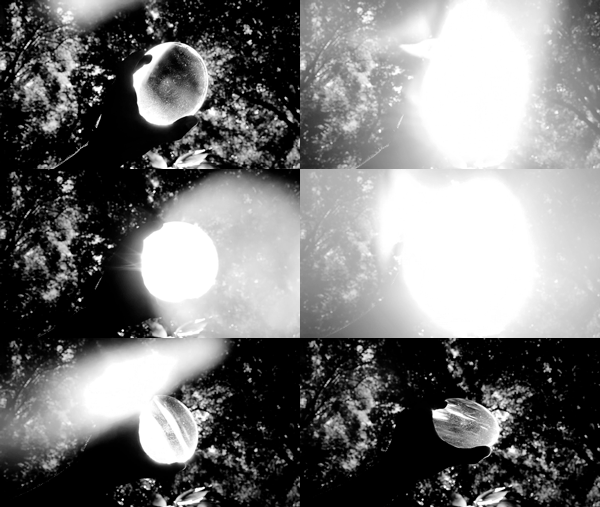
In Evento Celestial (2020–2023) we see the image of a hand holding a lens in front of the sun. It moves, directing a beam of light toward the observer. Mounted in backlight, the image blurs the boundaries between photography and cinema, graphic light and emitted light. There is in the work a certain rite, or magical act, of manipulating, altering, and directing sunlight. On the border between a prosaic scientific device and an act of luminous magic. For alchemists, gold is a shadow of the Sun, just as the Sun is a shadow of the One. Thus, a manipulation of solar force is also a glimpse, a breath, of the original presence that permeates everything.
The series Solaris Discotecum (2023) takes as its starting point the idea of harmony and movement in the cosmos as a musical premise. In it, we understand the sky as an environment in which one dances, in which light illuminates celestial bodies, and in which movement is one with music. A solar discotheque, then. The dance floor as a premise for the experience of celestial cycles.
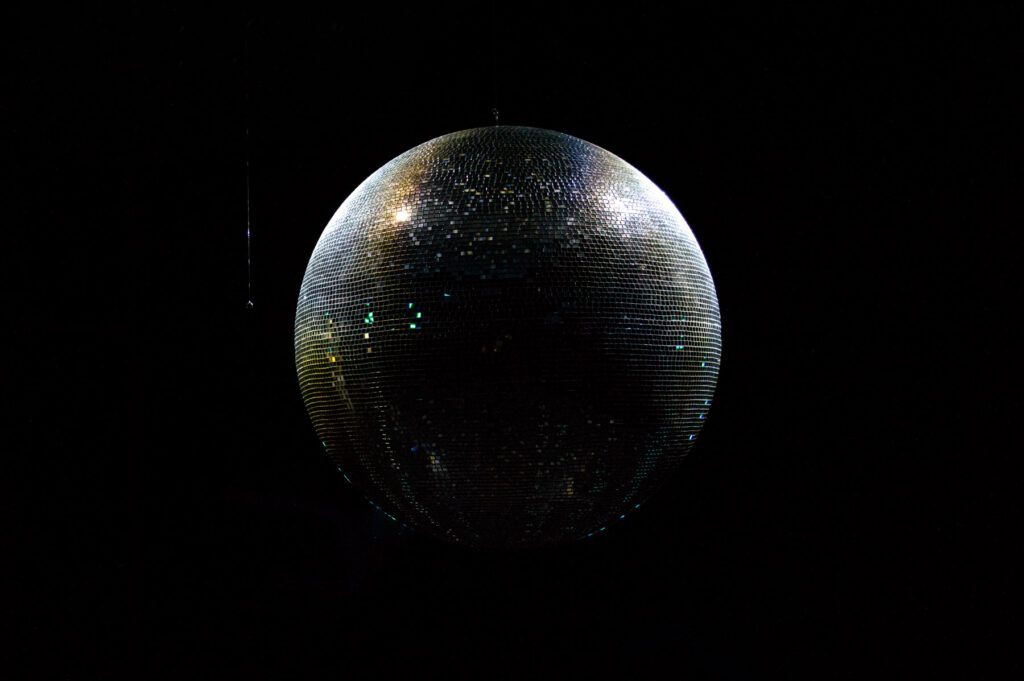
At the center, Orbis Solaris, from the series Solaris Discotecum (2023). Its many mirrors reflect light from above, illuminating the astronomical and astrological model set within the space, standing in for the king star. Around its axis circles a tiny, almost invisible sphere of lead: a modest 5mm representation of Planet Earth, proportional in scale to a 50cm-diameter Sun. Eternally wandering in circles under the light of the stars. Cycle after cycle, passing through its transmutative process until it becomes gold in its coming moment of illumination.
Since Babylonian civilization, we have used very similar symbols to represent the constellations of the zodiac ring. These 12 star groups lie along a plane through which the Earth passes each year, one month within each. In numerous non-Western traditions, we also find chronological and mythological interest in these same stars — with images that evoke their own cultures but that, at the same time, belong to a certain universality and omnipresence of these celestial bodies, observed by different human groups across different historical periods. It is intriguing and fascinating, this repetition of forms, allowing for variation among themselves while corresponding, reasonably, to the same star clusters. A kind of cave painting drawn generation after generation into the depths of the firmament.
Thus, Solaris Discotecum (2023) presents in neon a series of geometric abstractions of the possible connections between the stars related to each constellation of the zodiac. Each map presents its own interpretation of how each star connects to form a drawing that would come to be read as a crab or a scale, a lion or a goat. Dozens of star charts were consulted in order to find the similarities and differences between them. Some decisions were visual and compositional, others a matter of translation and adaptation from one to another. But in all of them, the same restlessness: to understand how so many peoples inferred such complex images from simple abstractions of lines and points in the sky.
Each of the luminous sculptures is made of glass tubes filled with argon, a noble gas produced at the core of massive stars in our galaxy. Thus, each work in the series is made of the very material emanated by the stars. The representation and the represented, made of the same matter.
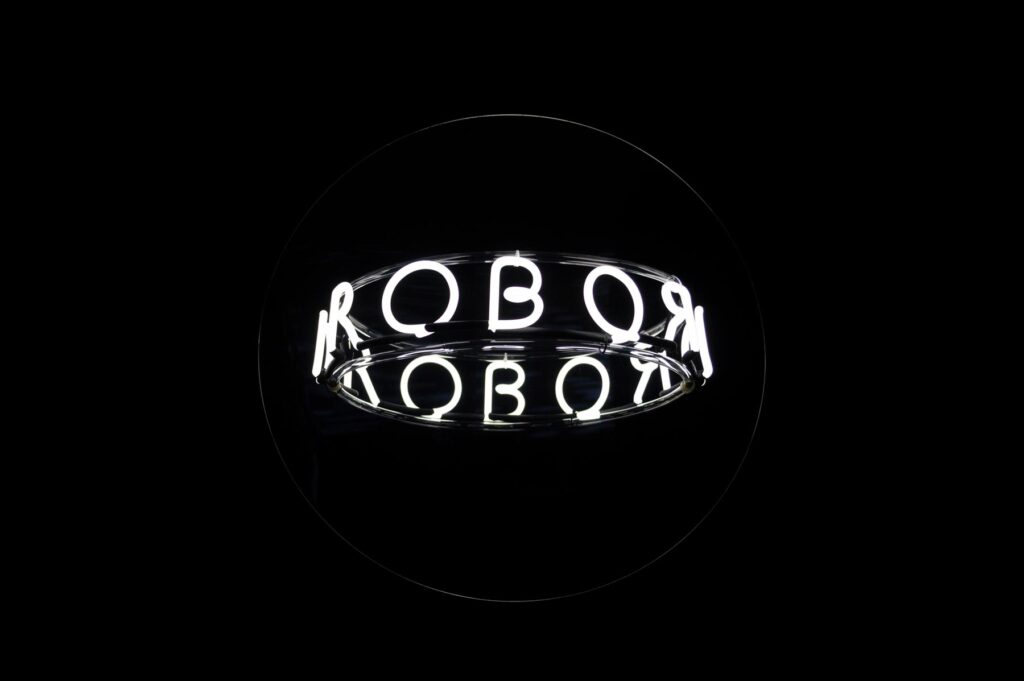
At the end of the show, and of the transmutative process it proposes, we are met with OROBORO (2023). In it, we evoke the word that names the alchemical symbol of the snake or dragon devouring its own tail, in a powerful allegory of the eternal return. The term is a palindrome, readable in both directions. Written as a semicircle over a mirror, its reflection transforms it into a ring-poem — a circular word that can be read eternally from any point. At the end of the great cycle of purification, the mystical serpent confronts us with its inescapable circularity and hurls us once more back to the beginning.
In this way, OVO CÓSMICO is at once a celestial dance floor, an alchemical cabinet, an astronomical model, and an astrological temple. It is both exhibition and initiatory path. A plethora of seductive luminous objects as much as a collection of magical artifacts. Like our multiple lives on the wheel of the world, it can be as overwhelming as it can be emptily materialist. As above, so below; as below, so above. Thus are made the miracles of a single thing.
Felippe Moraes
November 2023