Felippe Moraes
Movimento Pendular #1 (Pendular Movement #1), 2014
Steel cable, glass and sand
Variable dimensions
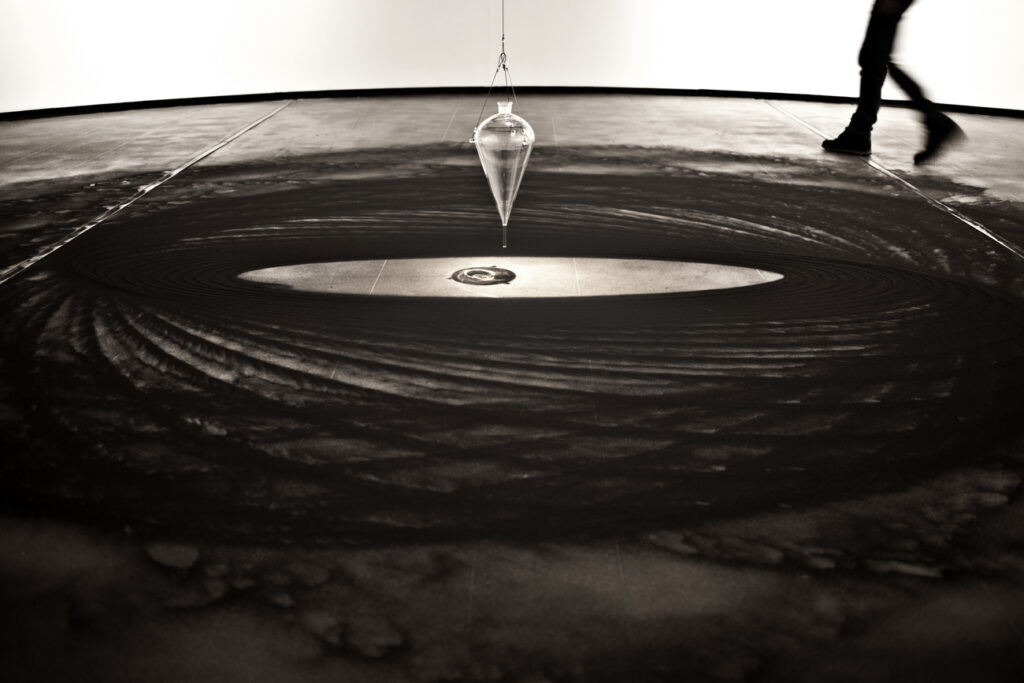
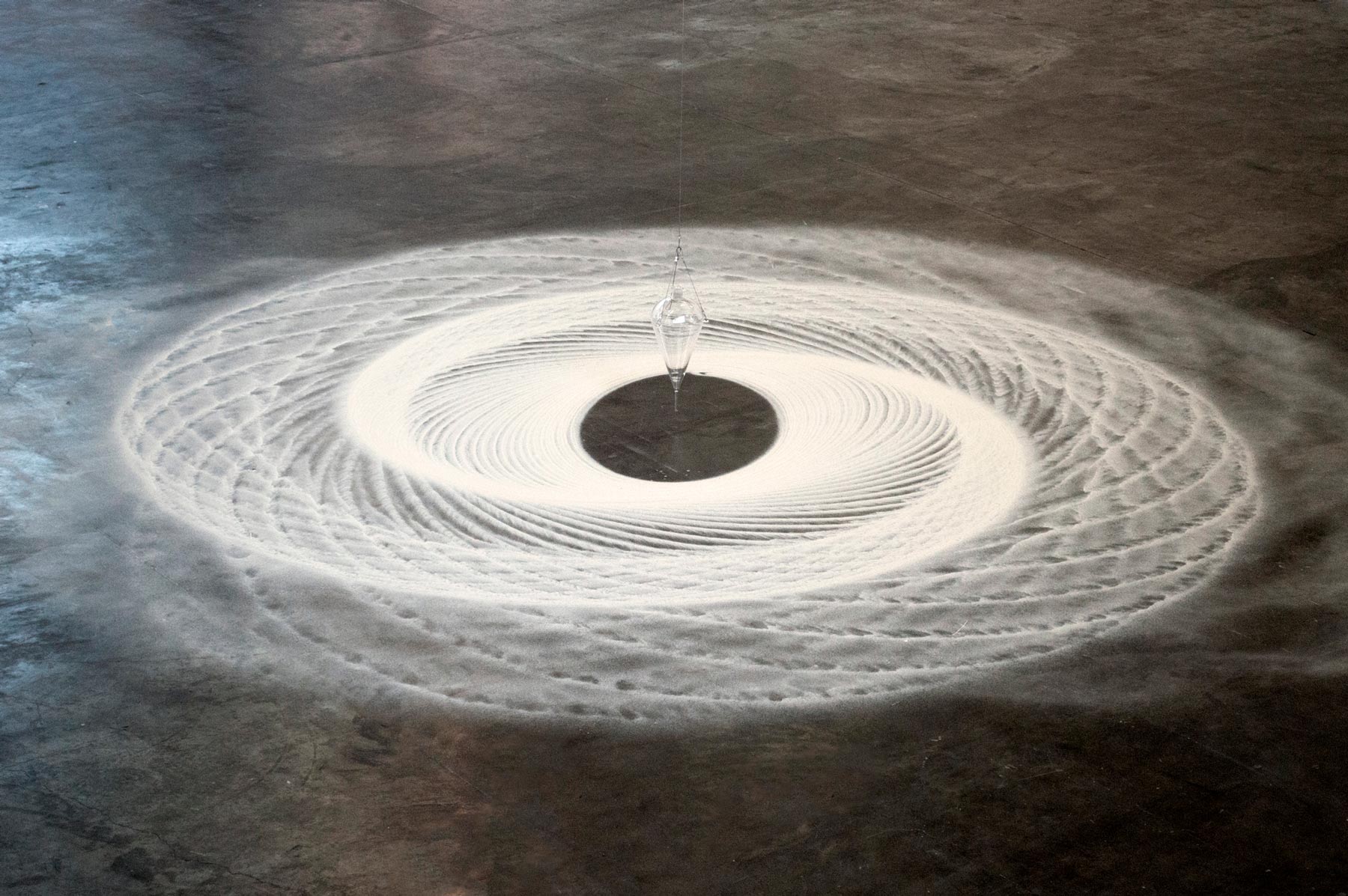
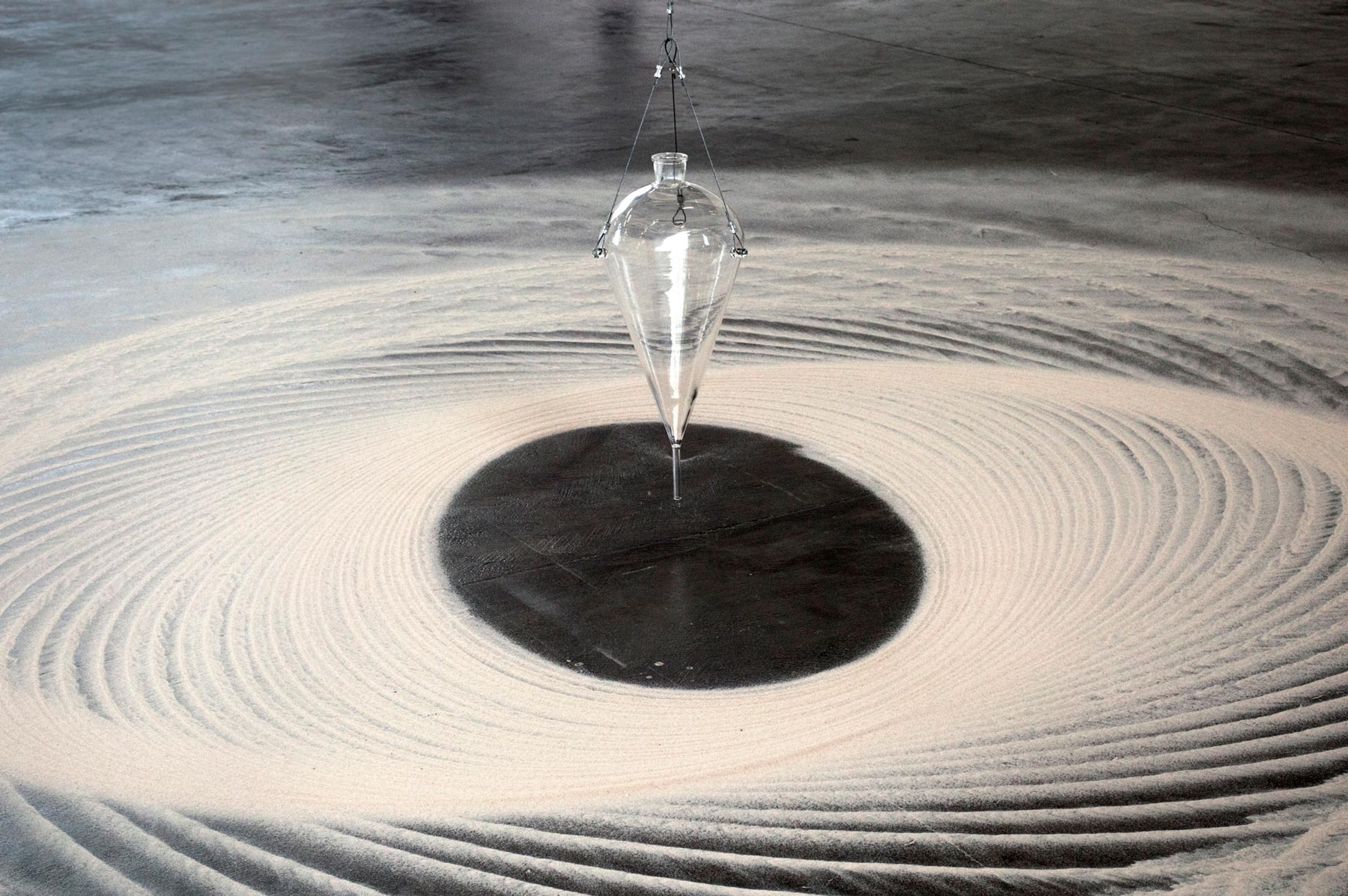
Movimento Pendular #1 and #2 (2014), by Felippe Moraes, investigate how physical phenomena can produce images directly in space.
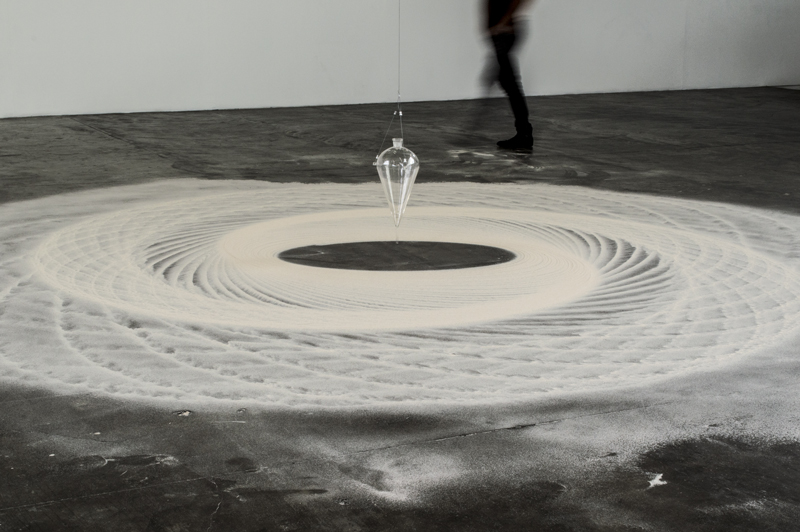
The work consists of a pendular device suspended above the ground. A container of sand is set in motion and slowly releases its material as it swings. As it moves, the pendulum deposits a continuous trace that records, on the ground, the path it has traveled.
The drawing is not planned in advance. It emerges from the physical system’s own behavior: small variations in amplitude, direction of movement, and environmental conditions continuously reshape the pattern generated. Each activation of the work therefore results in a singular image.
The work turns movement into visible form.
As it records the pendulum’s displacement, the sand functions as a medium for inscribing movement in space.
Each line corresponds to the device’s passage at a given moment. The resulting drawing accumulates these successive trajectories, revealing patterns of repetition, variation, and balance.
Although governed by simple physical laws, the images produced display great formal diversity. Small changes in the system’s conditions progressively alter the drawing, so that no configuration repeats itself in exactly the same way.
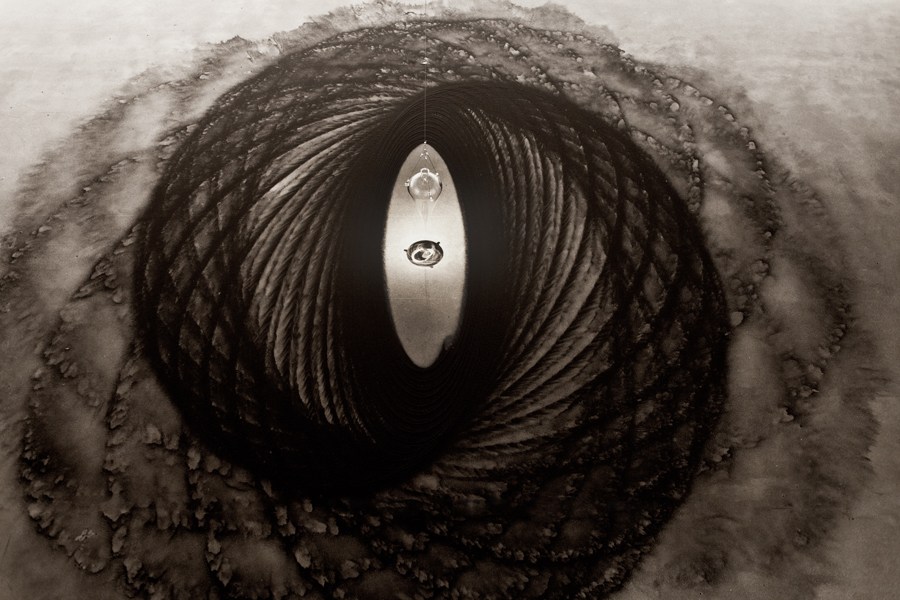
Movimento Pendular #1 (2014) at the solo exhibition Ordem (2014) at Baró Galeria (SP).
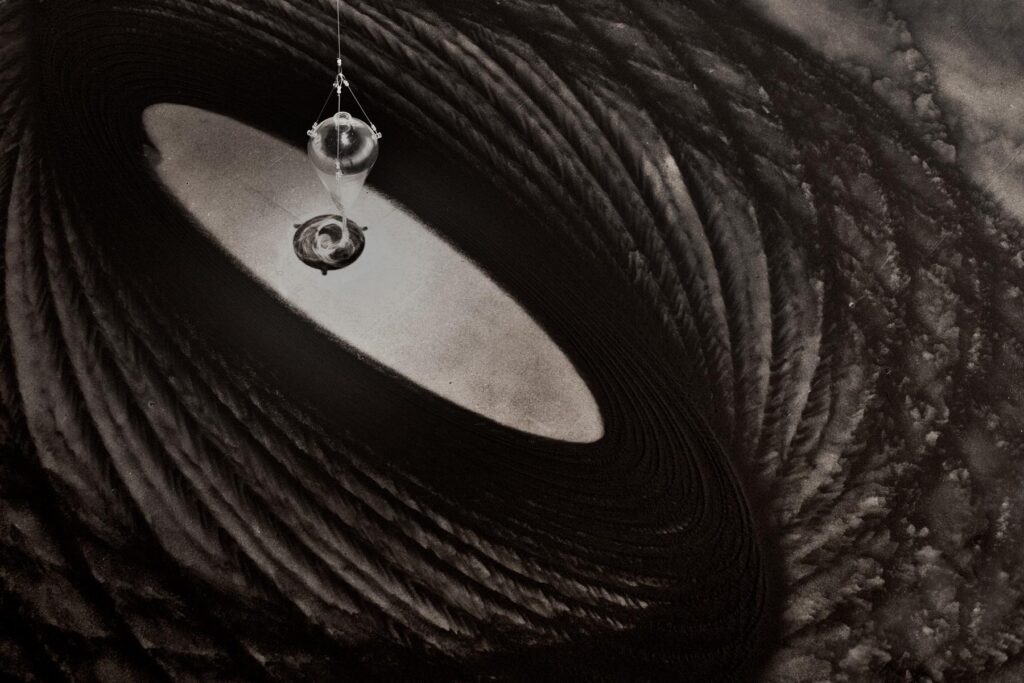
Lissajous Curves
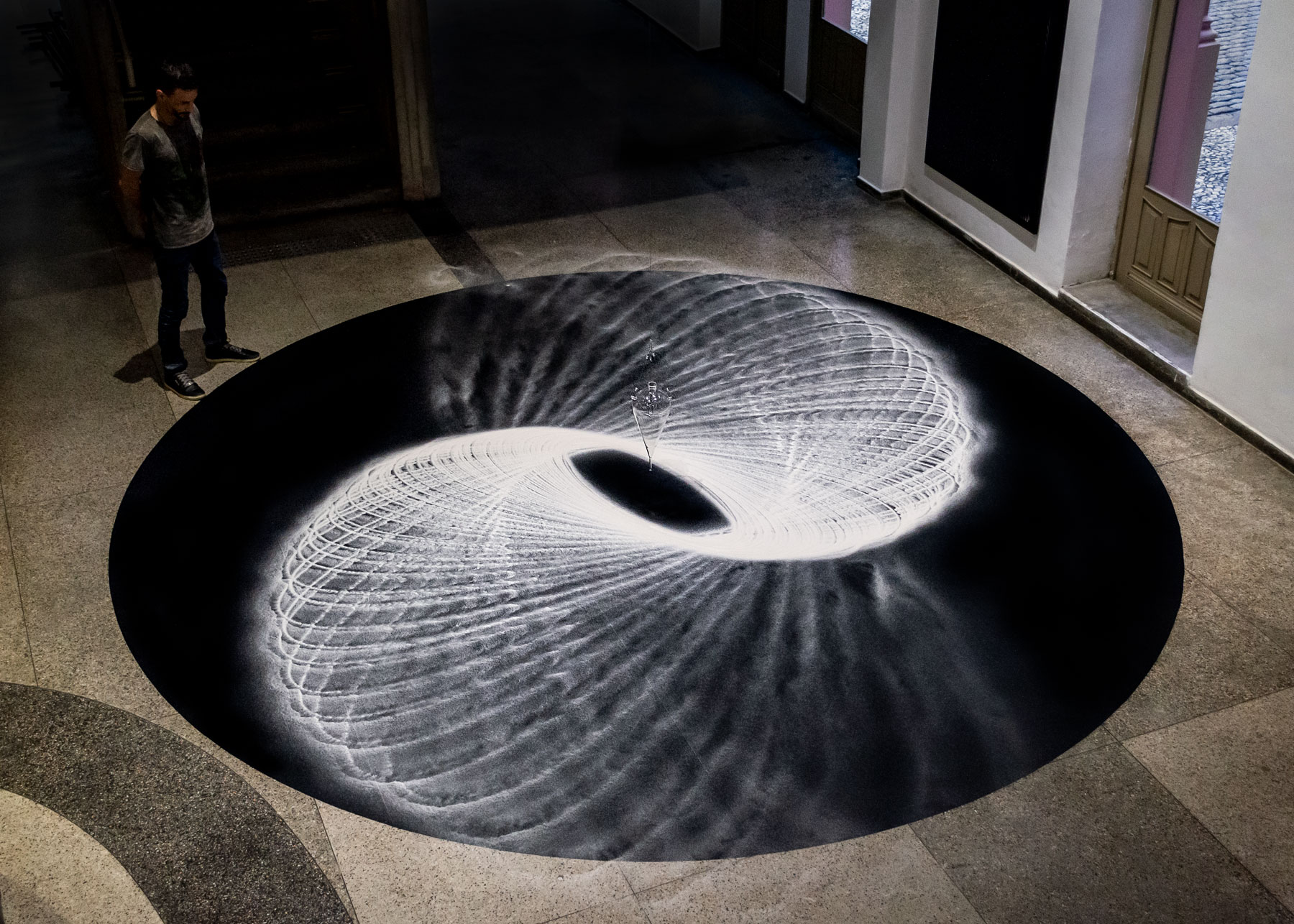
The images produced by the device belong to a family of mathematical patterns known as Lissajous curves.
These figures arise when oscillatory movements combine along different directions. Depending on the relationship between their frequencies and amplitudes, the result can range from simple ellipses to complex networks of interlaced curves.
In the installation, these mathematical relationships no longer exist only as a theoretical model — they come to manifest materially. The pendulum’s movement directly converts these relationships into lines of sand deposited on the ground.
The system thus functions as an instrument capable of making visible geometric structures that normally remain abstract.
The same process occurs in the photographic series Movimento Pendular (2015–17) (Pendular Movement, 2015–17), where the artist traces the same figures with light on the camera’s sensor.
The figures produced by the installation are extremely fragile. Air currents, vibrations, or the movement of people through the space gradually shift the lines of sand.
Over time, the patterns begin to come undone, dissolving into new arrangements.
This process reveals the transitory nature of the images generated by the work. The drawing is not a fixed object, but the temporary trace of a movement in progress.
Thus, Movimento Pendular #1 and #2 present the drawing not as representation, but as the direct consequence of a physical system in activity.
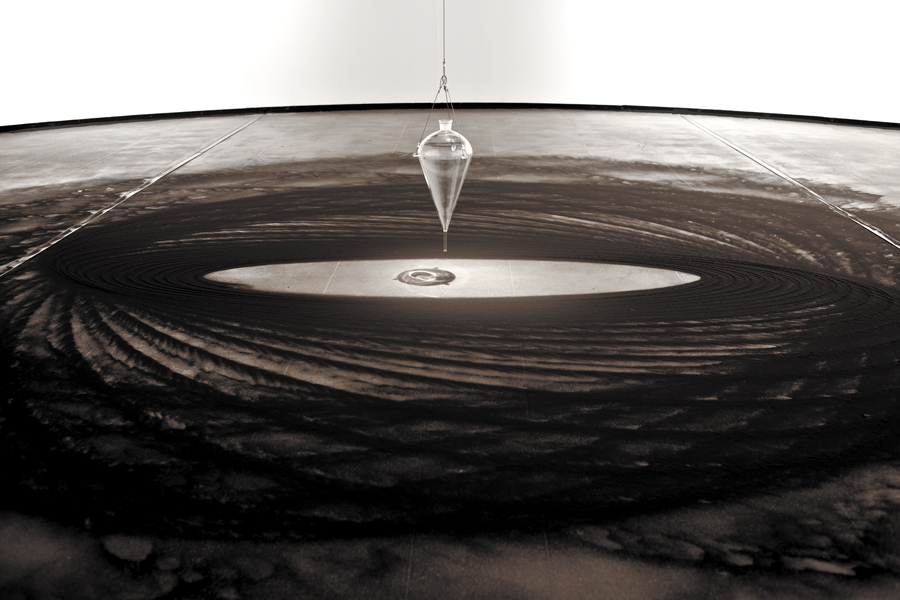
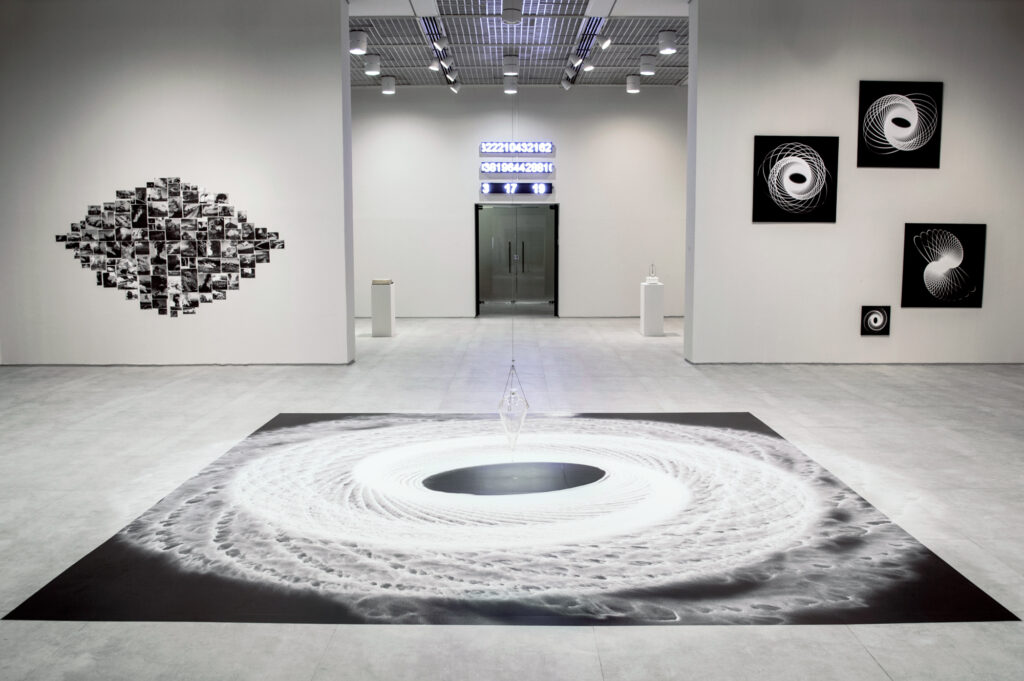
The Movimento Pendular series is based on elementary principles of physics: gravity, inertia and oscillation. Once set in motion, the pendulum continually seeks a point of equilibrium, while small variations in the system produce progressive deviations in its trajectory.
These variations turn an apparently simple mechanism into a complex generator of forms. The combination of physical forces and minimal displacements creates patterns that gradually expand through space, organizing themselves into curved, interconnected structures.
In this sense, the work reveals how natural systems can produce sophisticated geometries from basic rules. The drawing that emerges is not imposed by the artist, but results from the interaction between the device, matter and environmental conditions.
The installation thus functions as a field of observation where invisible processes — gravity, oscillation and equilibrium — become perceptible through the formation of the images.
Movimento Pendular #1 (2014) at the solo exhibition Imensurável (2018) at CAIXA Cultural Fortaleza.
Selected Exhibitions
- 2022 – 13ª Bienal do Mercosul – Casa de Cultura Mário Quintana (Rio Grande do Sul, Brazil)
- 2018 – Imensurável – CAIXA Cultural Fortaleza (Ceará, Brazil)
- 2015 – TRIO Bienal – Paço Imperial (Rio de Janeiro, Brazil)
- 2014 – Prêmio EDP nas Artes – Instituto Tomie Ohtake (São Paulo, Brazil)
- 2014 – Ordem – Baró Galeria (São Paulo, Brazil)