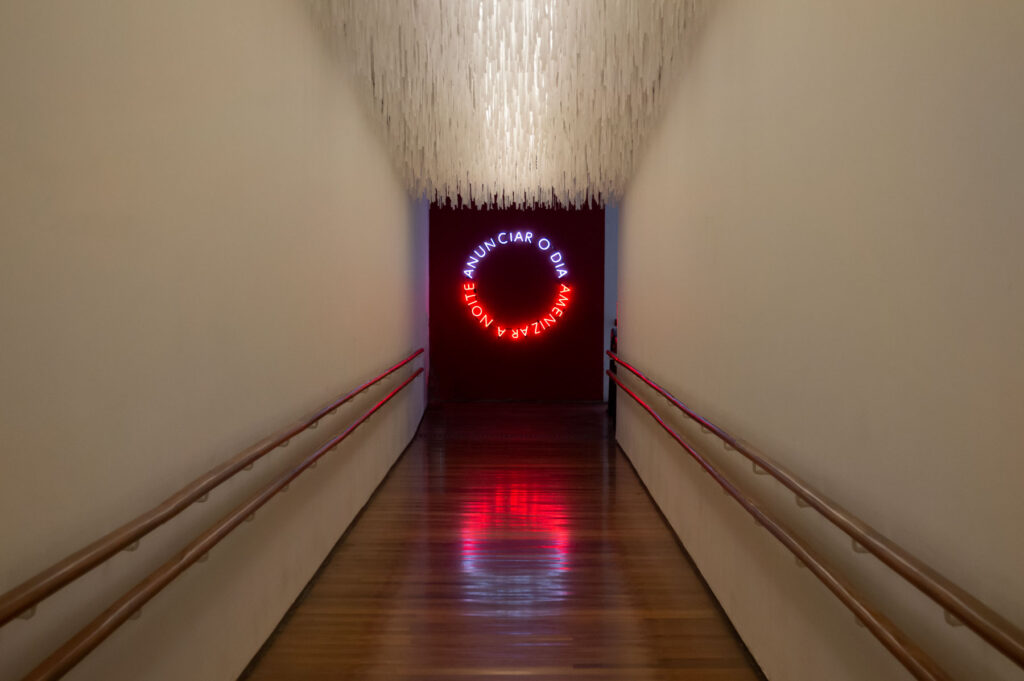
Anunciar o dia / Amenizar a noite (Announce the Day / Ease the Night), from the SAMBA EXALTAÇÃO series, 2021
Neon
130 × 130 cm
Ed. 3 + 1 AP
Collection: Museu de Arte do Rio
In the work Anunciar o dia / Amenizar a noite, the artist lights up in neon a line from the song Minha Missão (1981), by Paulo César Pinheiro and João Nogueira. By referencing these composers, Moraes not only pays homage to samba but also reveals his own artistic motivations. He connects himself to the sambistas who sing the experience of creation — its enigmas, its powers, its delicacies.
The luminous circle proposes an eternal return between night and day, sound and silence — a flow in which generations of artists take turns across time, each one searching, in their own way, for meaning and expression within the questions that run through them.
Felippe Moraes
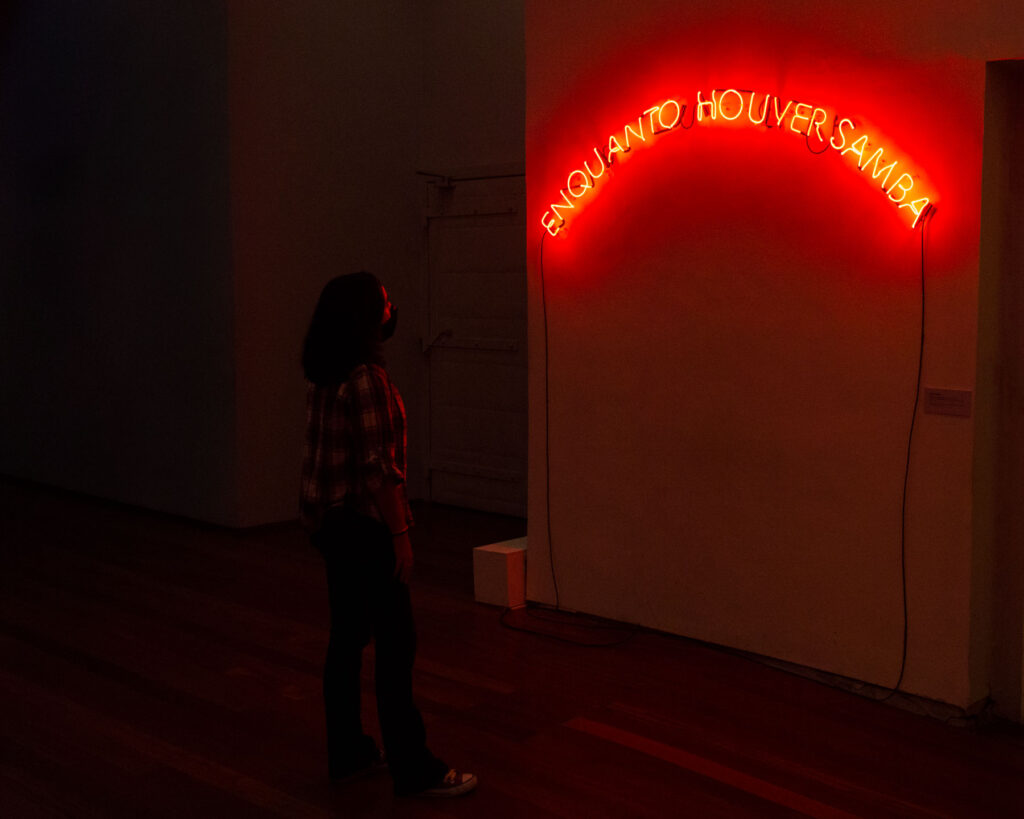
Enquanto houver samba (As Long as There Is Samba), from the SAMBA EXALTAÇÃO series, 2021
Neon
60 × 200 cm
Ed. 3 + 1 AP
Collection: Museu de Arte do Rio
In the work Enquanto houver samba (2021), the artist presents in neon an excerpt from the samba De Qualquer Maneira, composed by Candeia in 1971. The luminous phrase affirms the persistence of this cultural tradition as a vital force capable of moving through historical adversity. By turning the verse into a sculpture of light, the work reinforces the idea of continuity and resistance that runs through samba, suggesting that its presence remains lit even amid the transformations and tensions of urban life.
Felippe Moraes
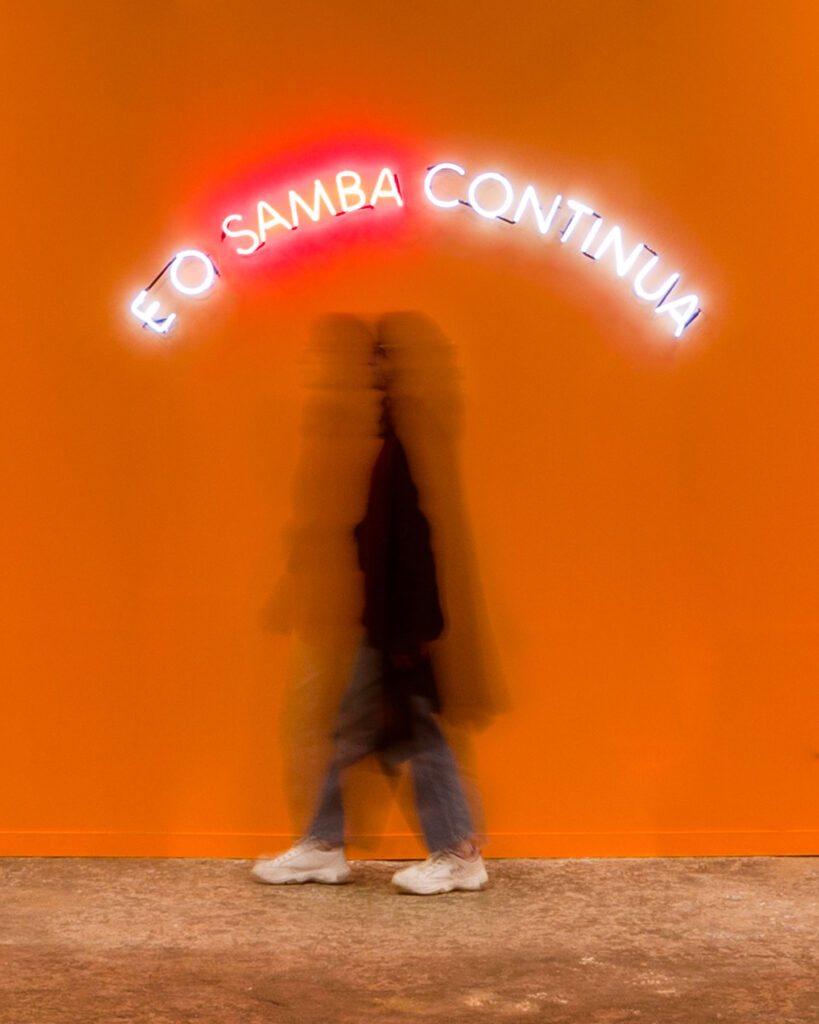
Exaltação à Vai-Vai (Exaltation to Vai-Vai), from the SAMBA EXALTAÇÃO series, 2022
Neon
Ed. 3 + 1 AP
The neon Exaltação à Vai-Vai (2022) draws from a line of the samba Tradição, composed in 1928 by Henrique Filipe da Costa. In a decade marked by modernism and profound urban transformation, samba affirmed its presence between ancestral memory and the emergence of a new urban culture. As cities expanded and bodies were shaped by the rhythm of industrialization, the batuques persisted as a living expression of collective creation, echoing verses that cross through time.
The work also evokes the history of the Vai-Vai samba school, often called the mother school of Bixiga. Its trajectory carries the mark of cultural resistance within a city that constantly threatens to erase its own gestures of origin. In this context, samba reappears as the memory of a creative force that insists on existing. Even compressed between concrete and asphalt, it finds gaps to keep vibrating, reaffirming the inventive power that runs through urban life.
Felippe Moraes
CANTA FORTE/ALTO, from the SAMBA EXALTAÇÃO series, 2021–24
Intermittent neon
700 × 80 cm
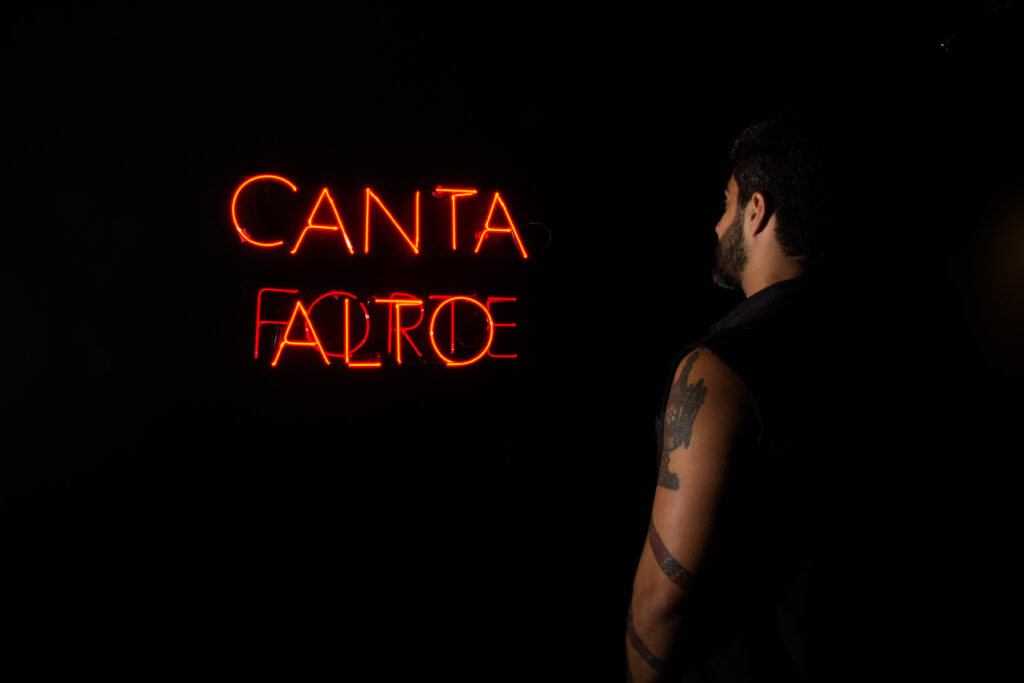
The neon CANTA FORTE/ALTO was first presented in a 7-meter-long version on the façade of the Biblioteca Mário de Andrade in São Paulo during the pandemic, in 2021. The public work, here presented in a reduced format, brings two lines from the song “Canta, canta minha gente” by Martinho da Vila. In many Afro-Brazilian terreiro traditions, the verbs to sing and to enchant are close and deeply intertwined. In this way, the work calls us toward a transformation of life and of relationships through song. From this understanding, we evoke the song’s following line, which tells us, as a consequence, that “life will get better.”
The songs presented in the SAMBA EXALTAÇÃO series draw on the popularity of their melodies, tied to their lyrics and inscribed in the collective unconscious. As we read the words that follow one another rhythmically through the neon’s flicker, we can hear, at the back of our minds, the voices we have already heard sing this samba. This luminous work thus also takes shape as a sound piece in silence, drawing on memory so that we may hum it mentally.
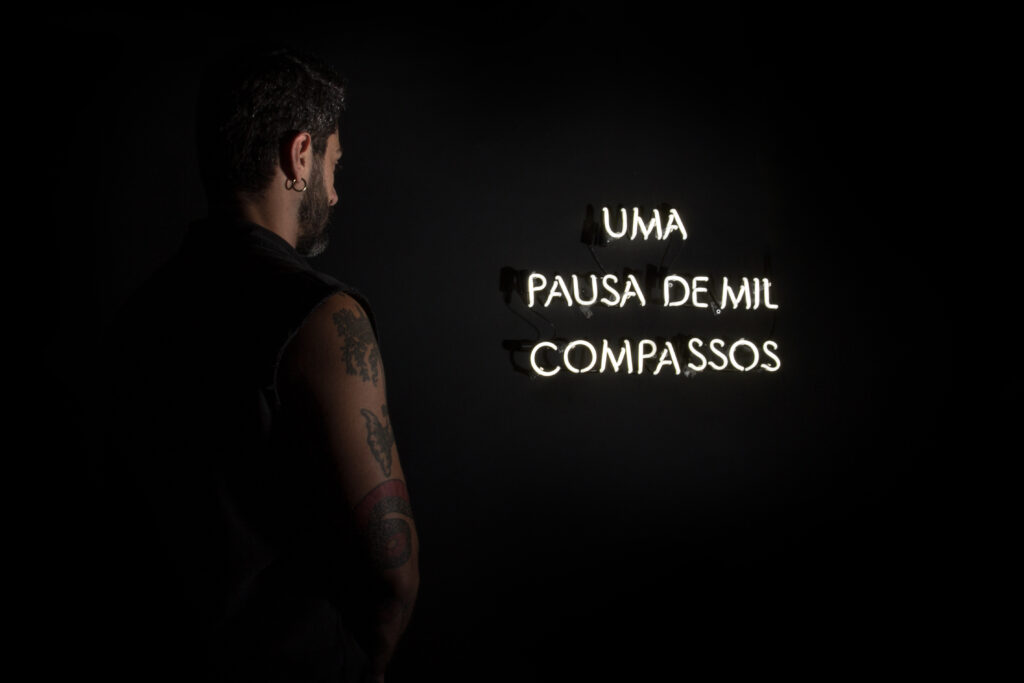
Uma pausa de mil compassos, from the SAMBA EXALTAÇÃO series, 2021–22
Intermittent neon
50 × 10 cm
Understanding samba as a Brazilian philosophical practice, the SAMBA EXALTAÇÃO series is built through the act of lighting up, in neon, powerful excerpts from popular songs. Taken from the song Para ver as meninas (1971) by Paulinho da Viola, the phrase “Uma pausa de mil compassos” lights up and fades within the span of a second, forming a kind of silent metronome.
Here, the work speaks about musical temporality, but also about its unraveling into an experience that is entirely personal and arbitrary. The concept of a beat allows us to understand it as a brief fraction of a second, or as the duration of a geological era.
Selected Exhibitions
- 2025 – Festival SESC de Inverno – Parque de Itaipava (Rio de Janeiro, Brazil)
- 2025 – Solfejo – CAIXA Cultural Curitiba (Paraná, Brazil)
- 2025 – Solfejo – CAIXA Cultural Rio de Janeiro (Rio de Janeiro, Brazil)
- 2024 – Solfejo – CAIXA Cultural Brasília (Distrito Federal, Brazil)
- 2022 – Rotas Brasileiras – SP-Arte / Verve Galeria (São Paulo, Brazil)
- 2022 – O que há de música em você – Galeria Athena (Rio de Janeiro, Brazil)
- 2022 – Arte e Tecnologia: Uma revolução em curso – MIS SP (São Paulo, Brazil)
- 2021 – Projeto Pilotis – Museu de Arte do Rio (Rio de Janeiro, Brazil)
- 2021 – Samba Exaltação – MAC Niterói (Rio de Janeiro, Brazil)
- 2021 – Ministério da Solidão – Oficina Oswald Andrade (São Paulo, Brazil)