Um Grito de Luz / A Cry of Light
by Daniel Rangel, 2021
Samba Exaltação Project
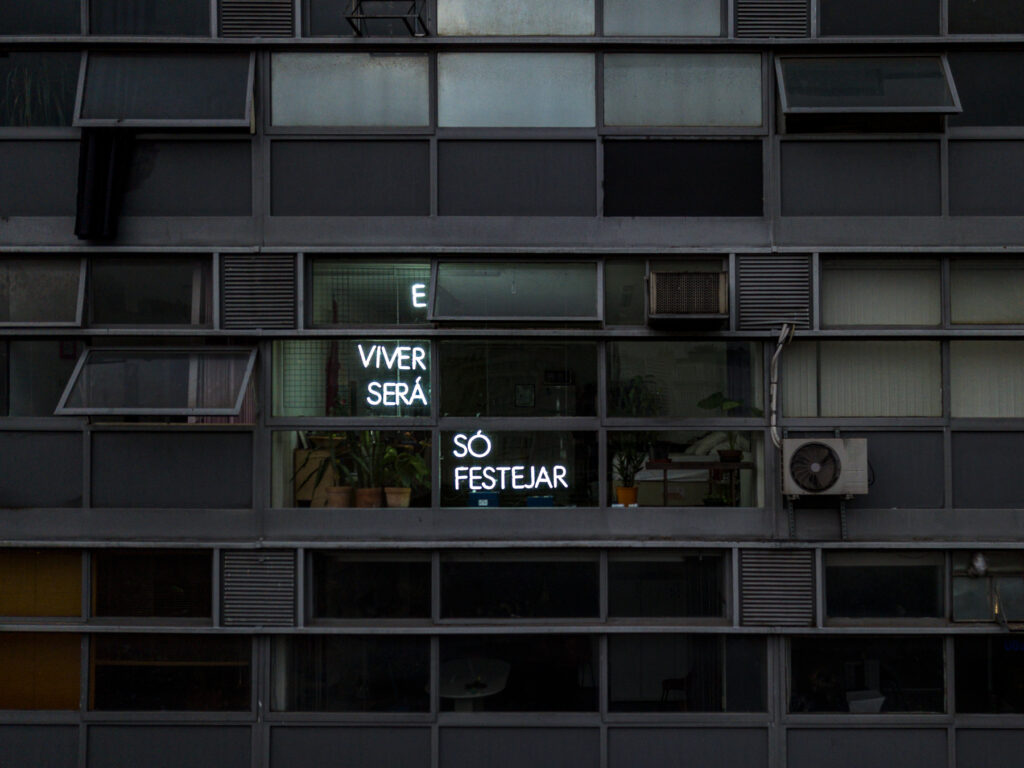
Mirante do Vale Building
In 1982, poet-artist Augusto de Campos — who recently turned ninety — exhibited his poem “O Quasar” on a luminous panel on the façade of a building in Vale do Anhangabaú, in downtown São Paulo. Journalist Telmo Martino, in a sarcastic tone, wrote about the intervention, remarking that Augusto de Campos had finally found his audience: the beggars and street kids of the city center. The irony became one of Augusto’s favorite criticisms, since it laid bare one of the concrete poetry group’s central aims — to make poetry popular and accessible to everyone. The expansion of poetry into other media has been, and remains, one of the most recurring strategies used by poet-artists seeking to explore the verbivocovisual dimension in their work. The concept, borrowed from the work of James Joyce, proposes the simultaneous union of verbal, visual, and sonic aspects within a single work. An intersemiotic connection that has influenced different artistic generations — neoconcretists, tropicalists, conceptualists, and tribalists — and that is intrinsically present in Felippe Moraes’s Samba Exaltação project.
Roughly forty years later, Moraes unexpectedly echoed the concrete poet’s gesture and proposed a series of verbivocovisual interventions on the façade of his apartment, in the iconic Mirante do Vale Building, the tallest in São Paulo, also located in Vale do Anhangabaú. Words written in neon reverberate like a luminous cry for “o olhouvido ouvê”1, questioning the present moment. Verses from carnival songs that sing of joy and celebrate life draw attention to death and the need to rethink daily life. There is nothing to celebrate: a year without festivities, without Christmas, without New Year’s Eve, without Carnival. The calendar stopped, and the natural rhythm of things was seemingly interrupted. The possibility of being in the streets, without limits or restraint, unleashing carnivalesque abandon, gave way to the conscious retreat of those helping to save lives. Moraes uses social media to share the perspective of a work that integrates the city and his home at once, connecting the public with the private.
The neon sign — cold and intense, a recurring artistic device, a means of communication in major cities, from shops to hospitals — here becomes a voice, even a kind of loudspeaker for a giant trio elétrico that has come to a halt. No samba was heard in Rio or São Paulo, no frevo in Recife, no axé in Salvador. Carnival’s own country is no longer the same, and hasn’t been for some time. The nation of the future has given way to a place mired in setback. Plurality and respect for diversity, sources of pride in past decades, have lost ground amid hate speech that seeks to segregate people. What is happening? Could it be that the natural rhythm was not interrupted after all, and we are in fact facing a catastrophic dystopia? Perhaps. Indeed, it is troubling to witness the insistence on a return to normalcy amid the sanitary, social, political, and planetary chaos we are living through. As Ailton Krenak put it: “Returning to normal would mean converting to denialism and accepting that the Earth is flat. That we must go on devouring one another.”2 (free translation) A message that ought to be echoed through every voice and means, including by artists, who are beacons lighting the way to the future. And who knows — someday, “to live will be nothing but celebration.”
Daniel Rangel
2021
1 Pignatari, Décio. Nova poesia: concreta (manifesto)
2 Ailton Krenak, in an interview with the newspaper O Globo, April 6, 2020. Accessed May 9, 2020. https://oglobo.globo.com/cultura/voltar-ao-normal-seria-como-se-converter-negacionismo-aceitar-que-terra-plana-diz-ailton-krenak-24353229.