Felippe Moraes
Solaris Discotecum series, 2023
Argon neon tubes, electric current, mirror ball, nylon, steel, lead and electric motor
Variable dimensions
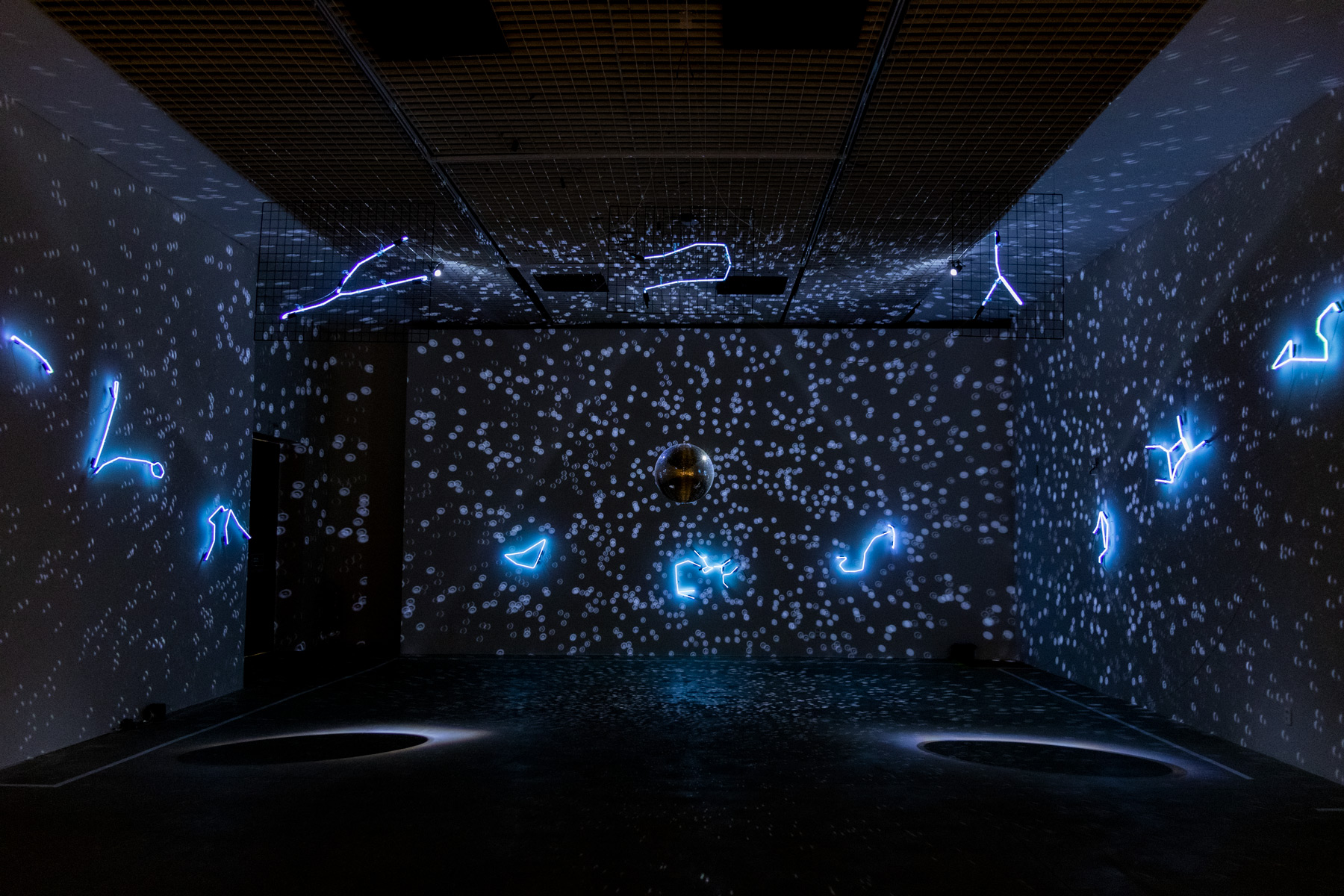
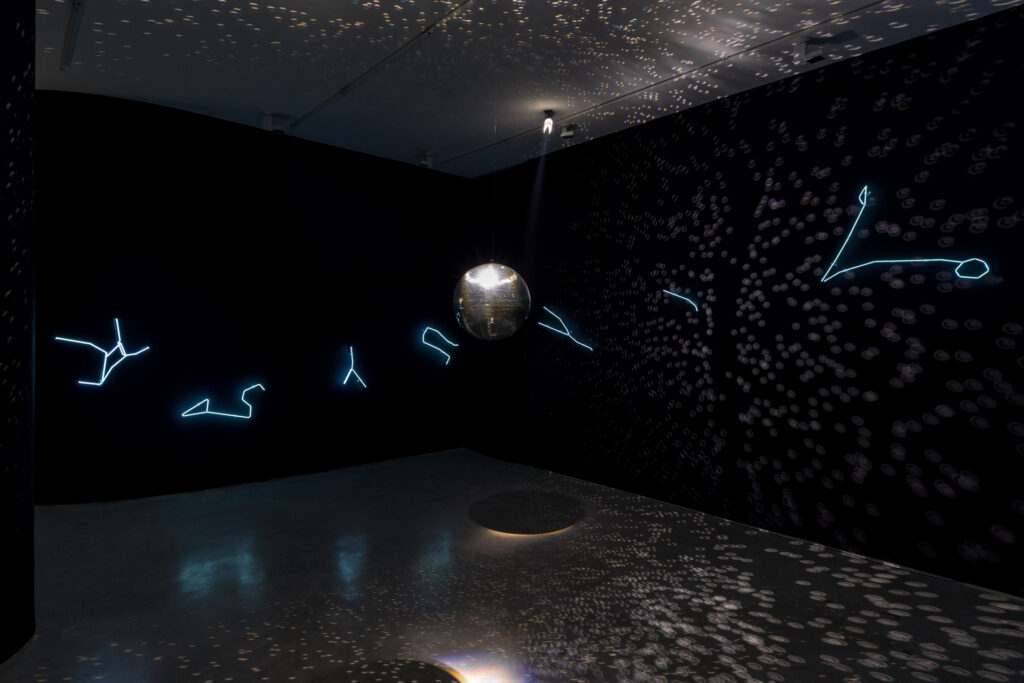
The series Solaris Discotecum (2023), by Felippe Moraes, proposes a cosmic model in which the twelve constellations of the zodiac symbolically surround Earth’s orbit around the Sun. The installation weaves together references to astronomy, the history of science, and the tradition known as the “music of the spheres,” which interprets the movement of celestial bodies as a form of universal harmony.
The project revisits questions explored by the artist in the work Harmonices Mundi (2017), inspired by the book of the same name published in 1619 by the astronomer Johannes Kepler. Starting from the idea that the movement of the planets could be understood as music, the work proposes a poetic exercise: imagining the cosmos as an infinite dance floor, where celestial bodies move in silent choreographies.
Orbis Solaris
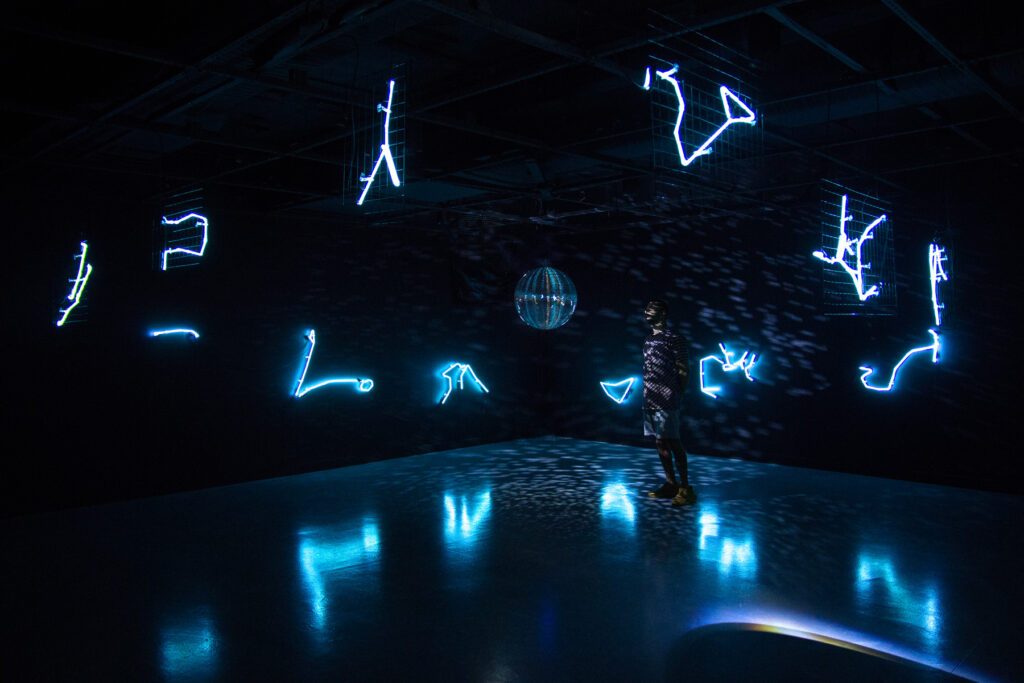
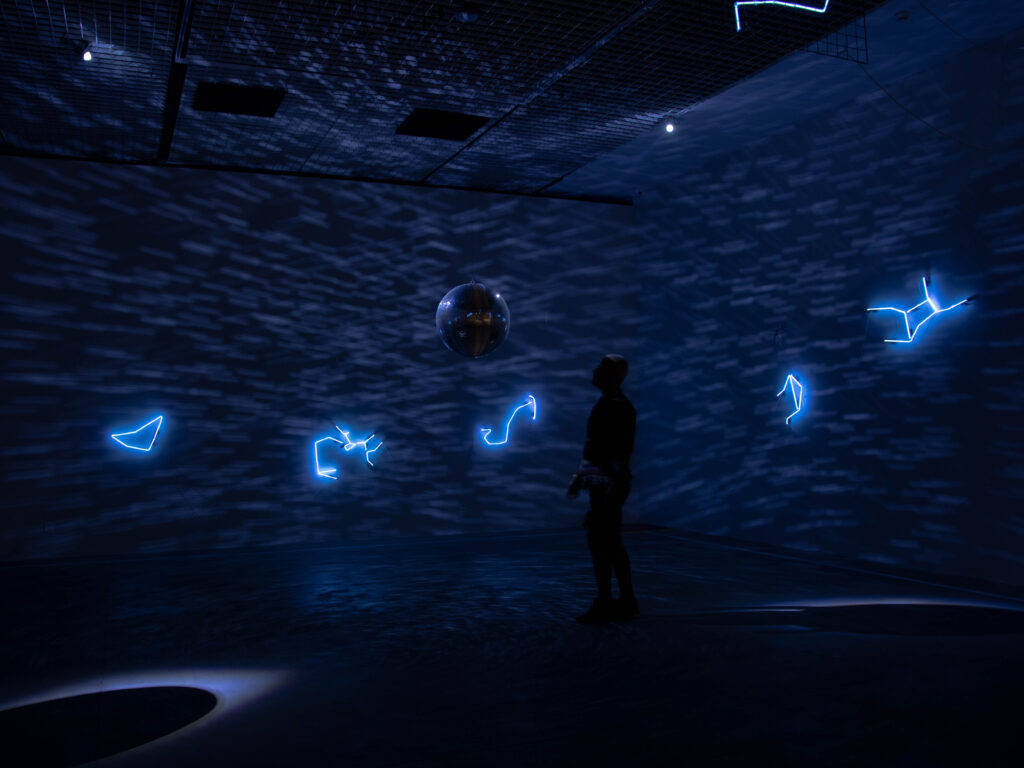
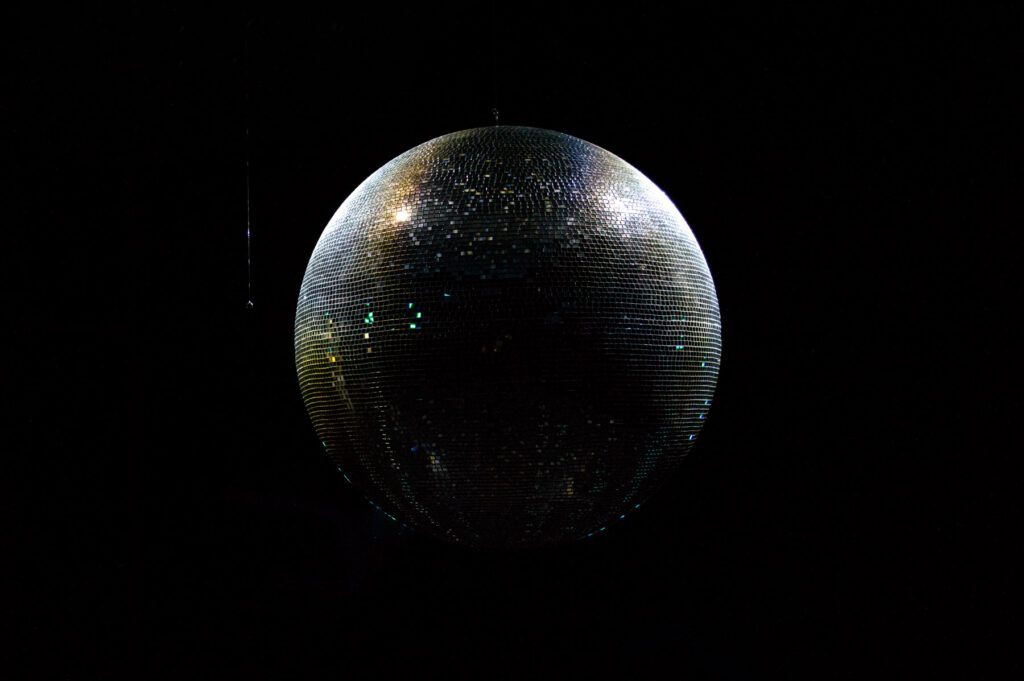
At the center of the installation is Orbis Solaris (2023), a sculpture composed of a fifty-centimeter mirror ball around which a small five-millimeter lead sphere continuously orbits. The scale relationship between the two elements approximately reproduces the proportion between the diameters of the Sun and the Earth. This continuous movement establishes a kinetic axis that organizes the installation, simultaneously suggesting the mechanical workings of an astronomical model and the circular rhythm of a dance floor.
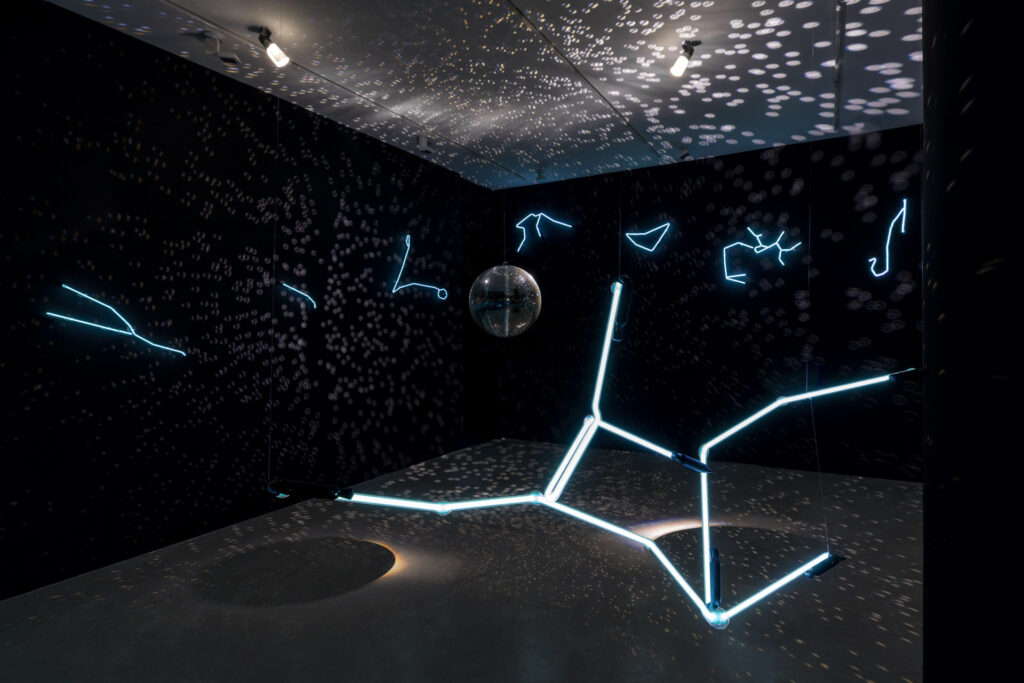
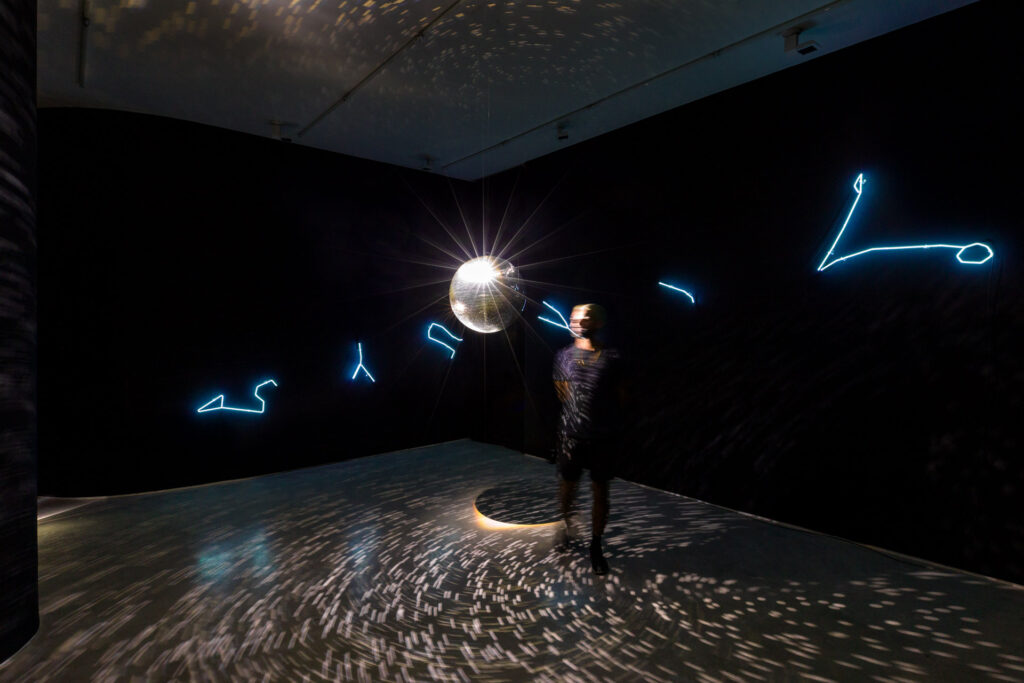
Around the perimeter of the work, neon tubes trace the outlines of the twelve zodiac constellations. These star groupings were observed and systematized by the Babylonians in antiquity, though versions of their myths and narratives appear across different cultures throughout history.
The luminous drawings presented in the installation were developed through the analysis of hundreds of historical celestial maps. From this research, essential elements of each representation were selected, and variations between different cartographies were reconciled. The result is a visual synthesis of these figures, passed down across millennia — almost a kind of cave painting projected onto the sky.

Stellar Matter
Each of the luminous sculptures is made of glass tubes filled with argon, a noble gas produced inside massive stars. In this sense, the constellations represented in the installation are built from the same kind of matter generated within the nuclear processes of stars.
In this sense, Solaris Discotecum establishes a poetic short circuit between representation and material origin. The matter that makes up the work is also stellar matter. The star that shines in the sky is the same one that, transformed into luminous gas, shines on Earth.
The zodiac constellations present in Solaris Discotecum also reveal the cultural dimension of skywatching. Though often associated with astrology, these figures originally emerged as forms of orientation and memory. By connecting seemingly scattered stars through imaginary lines, different civilizations created visual narratives capable of organizing the firmament and passing knowledge between generations.
By turning these constellations into neon sculptures, the work translates an ancestral symbolic system into a contemporary language. The artificial light that outlines the figures in the exhibition space draws a parallel between urban experience and nighttime skywatching. Visitors find themselves, at once, before a star map and a luminous environment reminiscent of both the nighttime cityscape and the atmosphere of a dance floor.
This meeting of scientific, mythological and sensory references brings Solaris Discotecum close to an artistic tradition that investigates the ties between art and cosmology. The installation invites the public to perceive the exhibition space as a microcosm, in which astronomical scales are translated into visual and bodily relationships accessible to human experience.
Selected Exhibitions
- 2026 – Telúricos – Galeria Nara Roesler (São Paulo, Brazil)
- 2025 – Solfejo – CAIXA Cultural Curitiba (Paraná, Brazil)
- 2025 – Solfejo – CAIXA Cultural Rio de Janeiro (Rio de Janeiro, Brazil)
- 2024 – Solfejo – CAIXA Cultural Brasília (Distrito Federal, Brazil)
- 2024 – Ovo Cósmico – Verve Galeria (São Paulo, Brazil)